.png)
Connecting Police, Fire and EMS to the Built Environment: The Future of Community Safety

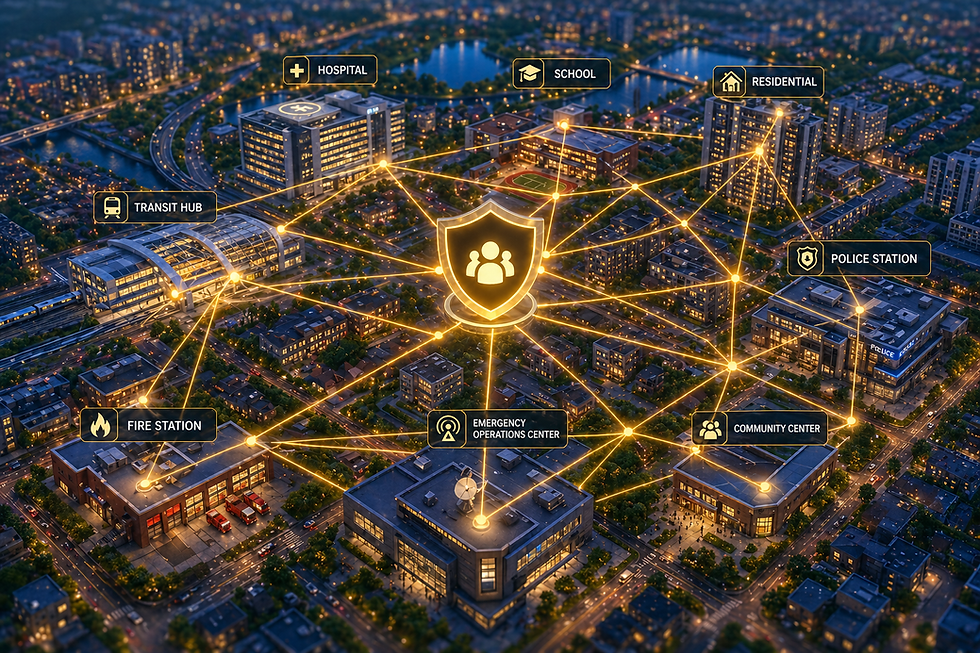
Across modern cities, most emergency incidents do not occur on open streets. They occur inside buildings.
High-rise residential towers.
Commercial office complexes.
Hospitals and schools.
Transit infrastructure.
Shopping centres and public venues.
For police officers, firefighters, and paramedics, the built environment is where emergencies actually unfold. Yet, despite the central role buildings play in public safety, emergency services have historically operated without a structured digital connection to the people responsible for those environments.
When responders arrive at an incident, they often face an immediate information gap. Critical building intelligence may not be available, or it may exist only in outdated binders, paper plans, or disconnected systems. It is that gap that can delay response and increase operational risk.
The “Safe Communities” platform, developed by Safe Buildings, was designed to close that gap and create a secure digital bridge between emergency services and the built environment.
The Missing Link in Community Safety
Police, fire, and EMS agencies are increasingly responsible for protecting complex urban environment, but the operational reality for frontline responders often looks like this:
Arriving at a building without knowing the layout.
Waiting for access to locked lobbies.
Searching for emergency contacts.
Trying to locate shut-off valves, hazardous materials, or evacuation routes.
These delays may seem minor, but during emergencies seconds matter.
For command staff, the lack of real-time building intelligence also limits situational awareness across the environments where incidents actually occur.
As cities grow vertically and infrastructure becomes more complex, this information gap becomes a structural challenge for modern public safety.
Introducing Safe Communities: A Secure Bridge Between Emergency Services and Buildings
Safe Communities is a secure digital platform designed to connect Police, Fire and EMS teams directly to the built environment. Instead of relying on fragmented records, the platform allows building operators to securely share verified safety information that authorized emergency responders can access when needed.
This includes critical operational intelligence such as:
• Building floor plans and aerial site maps
• Lobby access procedures and entry codes
• Emergency contact information for building management
• Evacuation routes and emergency procedures
• Locations of shut-off valves and life safety systems
• Hazardous materials and infrastructure information
• Locations of vulnerable occupants requiring assistance
Because the data is maintained by building operators, it remains accurate and up to date without creating administrative burden for emergency services. The result is a system where buildings shift from passive locations to active participants in community safety.
A Platform Designed for Police, Fire and EMS Operations
Safe Communities was designed with operational realities in mind. Frontline responders need information instantly, and Command staff require governance, security, and accountability.
The platform incorporates safeguards aligned with public-sector governance, including:
• Role-based access aligned with responder roles and ranks
• Complete audit logs of system activity
• Canadian-hosted secure data environments
• SOC 2 compliant digital infrastructure
• Identity integration with public safety systems
These controls ensure operational intelligence remains secure while still accessible to those who need it during emergencies.
Rapid Deployment Across Entire Communities
One of the defining strengths of the Safe Communities model is scalability. Entire municipalities can deploy the platform across their built environment within approximately 90 days. This allows police services, fire departments, and EMS agencies to quickly establish a secure network connecting buildings across their jurisdiction. Rather than building isolated programs building by building, communities can create a community-wide safety intelligence network.
This network connects:
Residential towers
Commercial office buildings
Hospitals and healthcare facilities
Schools and campuses
Religious Centres
Transit systems
Industrial facilities
Critical infrastructure sites
By connecting these environments to emergency services, cities gain a new level of situational awareness, and occupants and building. Owners benefit from better incident outcomes.
Real-World Implementation: Peel Regional Police
The Safe Communities platform is already being used in real operational environments.
Peel Regional Police partnered with Safe Buildings to launch a Building Access Program, designed to address operational delays officers experienced when responding to high-rise buildings.
Officers frequently encountered:
Locked lobby systems Unreachable building contacts Limited access to building layouts.
Using the Safe Communities platform, building operators can securely provide verified building intelligence and access procedures to emergency responders. The results have been significant.
Current deployment includes:
• More than 2,500 frontline officers using the system
• Hundreds of connected buildings across the community
• Hundreds of building administrators maintaining verified data
During the first 10 days of January 2026 alone, officers accessed the system 24 times during active emergency responses to support faster building access and improved situational awareness. This operational adoption demonstrates that the platform works in real emergency conditions, and Peel Regional Police are currently expanding the program.
How Safe Communities Improves Emergency Response
The Safe Communities platform strengthens emergency operations across several critical areas.
Faster Incident Response
Officers and responders gain immediate access to building intelligence before or upon arrival, reducing delays caused by searching for information.
Improved Officer and Responder Safety
Access to floor plans, hazard locations, and infrastructure information allows responders to make better tactical decisions.
Stronger Community Safety
Prepared buildings and coordinated response between property operators and emergency services reduce disruption and harm during incidents.
Increased Service Capacity
When responders resolve incidents faster, agencies can maintain operational coverage without increasing staffing levels.
Public Trust and Collaboration
When property owners participate directly in safety initiatives, trust grows between communities and public safety services.
A Community Safety Model Built on Prevention, Preparedness, Response and Recovery
The Safe Communities framework supports the full lifecycle of emergency management.
As illustrated in the platform’s operational model, the system supports four key pillars of community safety:
Prevention Preparedness Response Recovery
These pillars enable a coordinated approach where emergency services and building operators share responsibility for safety outcomes.
A Proven Path Forward for Modern Public Safety
Public safety leaders recognize that the environments they protect have changed dramatically. Modern emergency response requires more than vehicles and personnel.
It requires intelligence about the environments where incidents occur.
Safe Communities provides that intelligence.
By creating a secure channel between emergency services and buildings across a community, the platform delivers:
Real-time building intelligence
Faster emergency response Improved responder safety
Better coordination with property operators
Enhanced community resilience
Safe Communities does not replace existing police, fire, or EMS systems.
It connects them to the built environment where community safety actually happens.
Building Safer Communities Together
For municipalities, police services, fire departments, and emergency management leaders, the question is no longer whether the built environment should be connected to emergency services. The question is how quickly communities can establish that connection.
With Safe Communities, cities can deploy a secure, scalable platform in approximately 90 days, creating a digital safety network that connects responders, buildings, and communities.
When emergency services have the information they need when they need it response improves. And when response improves, communities become safer.
Learn More
Explore how Safe Communities connects Police, Fire and EMS teams with the built environment to strengthen community safety.


Comments