.png)
Safety Systems Are Only as Strong as Their Implementation

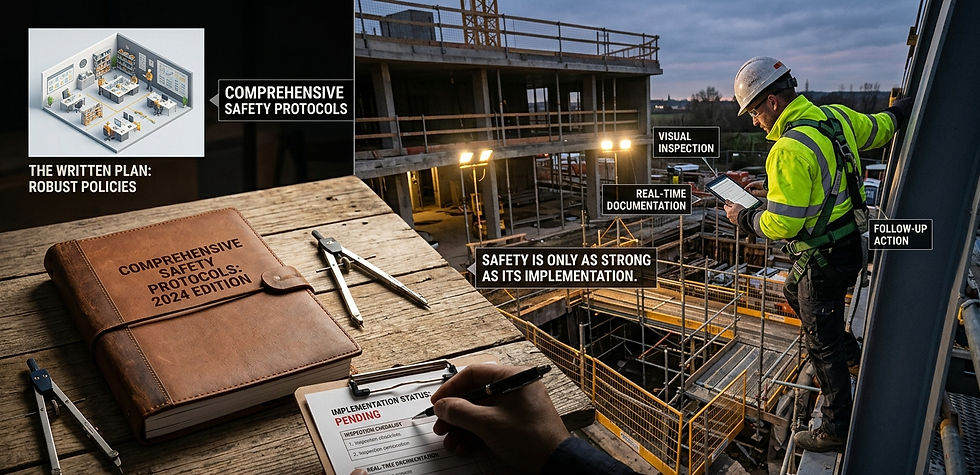
The Vital Role of Inspections and Documentation in Protecting Workers and Reducing Liability
In the built environment and across a wide range of industries, most employers and property owners can proudly point to binders filled with policies, or manuals outlining procedures and emergency protocols. On paper, safety systems appear robust and well-considered. Yet, time and again, it is not the absence of safety policies that results in tragedyit is the failure to implement and verify them through consistent inspections, documentation, and follow-up.
Recent incidents underscore this critical gap between policy and practice, and highlight the real-world consequences of failing to uphold what’s written in the safety plan.
A Fatal Oversight in Edmonton
In a tragic case out of Edmonton, a commercial food processing company pleaded guilty to a workplace safety violation after a worker became trapped inside a smokehouse and died. The emergency release handle was broken something a basic inspection could have easily identified and corrected.
During sentencing, Crown prosecutor Hendrik Kruger made it clear: the company had “a comprehensive safety system in place” but failed to ensure compliance through inspections and failed to train staff on the use and function of critical emergency equipment. This fatal lapse in implementation reveals the systemic danger of assuming that written policies are sufficient on their own.
Ontario Case: A Supervisor’s Accountability
Closer to home in Ontario, a workplace incident led to a supervisor being sentenced to five years in prison after a worker was fatally injured. Investigators concluded that routine inspections and proper follow-up could have prevented the incident entirely.
This case also reaffirmed that employers must appoint “competent persons” as supervisors. In Ontario, that means individuals who are trained, knowledgeable in health and safety legislation, and aware of both current and potential hazards in the workplace. Failing to ensure this standard can result in criminal liability not just for corporations, but for individuals in positions of responsibility.
Bridging the Gap: Policy vs. Practice
These tragedies are not the result of negligence in creating policy but rather in implementing the basics: inspecting, documenting, and correcting. A strong safety culture requires leaders to do more than delegate. It demands oversight, documentation, and a cycle of accountability.
For those responsible for staff, buildings, or workplace operations, key takeaways include:
Regular, documented inspections of safety systems and emergency equipment.
Verifiable staff training on the use and testing of safety systems.
Ensuring that hazards identified in routine inspections are addressed and tracked to resolution.
Maintaining comprehensive, accessible records to prove due diligence.
Compliance Isn’t a Binder on a Shelf
In any building commercial, industrial, or residential it is not enough to have safety policies in place. The law, and more importantly, the safety of people, demands implementation, inspection, and documentation.
By embedding inspection routines into daily operations and treating documentation as a cornerstone of due diligence, Owners and Managers can protect their teams, reduce liability, and most importantly, prevent loss of life.
Safe Buildings – Compliance made simple

Comments